
LeviNeT: What It Is and Why It Matters
LeviNeT is a research project funded by the European Research Council (ERC) through a Starting Grant worth €1.19 million. It runs for five years (2022-2027) and aims to develop an open access digital edition of Primo Levi’s correspondence with his German and German-speaking interlocutors from the late 1950s to the mid-1980s. It is directed by Prof. Martina Mengoni at the University of Ferrara, in partnership with the Centro Internazionale di Studi Primo Levi, which supports the LeviNeT team in its archival research. The Centro also organised and curated the exhibition Giro di posta. Primo Levi, le Germanie, l’Europa, which was inaugurated in Turin in January 2025 and will be displayed in Ferrara in January 2027.
The German correspondence is not one of the many: it represents Levi’s attempt to «understand the Germans» in the years following the publication of Se questo è un uomo in West Germany. Simultaneously, it also constitutes a unique case of European cultural history: a former deportee who entered into dialogue with the “people” of his persecutors. Finally, it tells the story of a book that serves as a lens to examine crucial questions about the past and present of Europe.
The letters published in this edition come from Primo Levi’s private archive, which made this material accessible for the first time, and from various private and public European archives. LeviNeT also involves the reconstruction of biographies and stories: individual experiences that reflect the historical events of postwar European history.
The edition
The core of the project is the digital edition of the correspondence, available on the portal www.levinet.eu. From 1963 on, Levi planned to publish his correspondence with his German readers of Ist das ein Mensch? (the German edition of Se questo è un uomo) in some form. As this editorial project never came to fruition, he eventually presented and translated a small anthology of these letters himself in the last chapter of his final book, I sommersi e i salvati. The LeviNeT digital edition can be understood as the development of what that chapter might have become, like an exploded-view diagram that makes it visible and lends it substance. The map on the homepage reflects this idea: Levi stands at the centre, surrounded by all his German correspondents in a complex constellation.
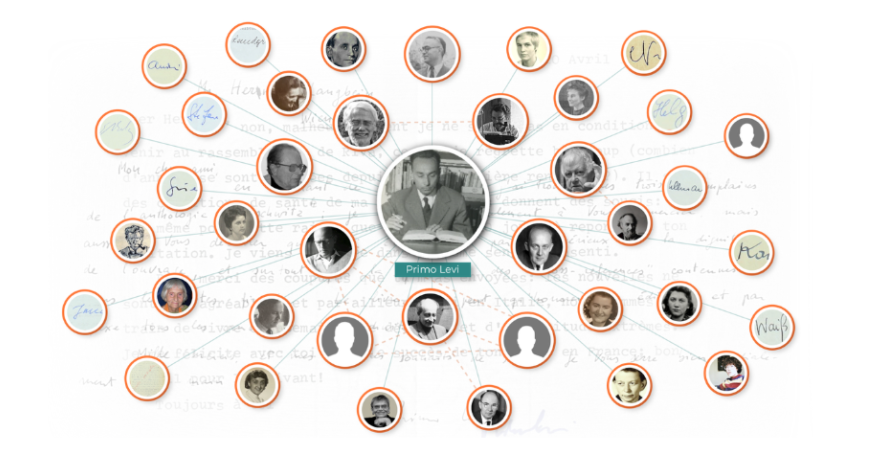
Every letter is assigned a sequential number, yet the digital edition is non-linear and dynamic by its very nature. It is the ideal format for representing a multifaceted object such as Levi’s German correspondence, which emerged from a shared and pressing core theme but then developed in different directions and registers. LeviNeT brings together at least three kinds of epistolary exchanges:
1. The editorial correspondence
- The Letters with the German Translator.
The correspondence with Heinz Riedt is the body of letters from which the whole story originates in 1959. It comprises about 200 letters documenting a twenty-year friendship, which was born out of intense exchanges on language and grew into a privileged relationship. The letters have so far been partially published in the volume Il carteggio con Heinz Riedt (Einaudi, 2024), edited by Martina Mengoni. The complete correspondence will be published here in 2027.
- The story of a book that was never published.
This section provides a detailed reconstruction of the complex editorial history of censorship, only partially known until now. The edition makes available for the first time Primo Levi’s complete correspondence with two cultural mediators working in East Germany in the 1970s and 1980s: Joachim Meinert, editor at the publishing house Aufbau Verlag, and the writer Fred Wander. The correspondence is published along with two essays examining the editorial reviews and various other unpublished archive materials.
2. The Correspondence with former prisoners
- The «formidable man» and the «ordinary man with good memory»
The encounter with Hermann Langbein, through his books and his personality, was crucial to Levi’s personal and intellectual development between the 1960s and the 1980s. Their correspondence shows how deeply Levi admired the work of one of the main historians of the Nazi concentration camps, who also promoted the prosecution of Nazi crimes and was active in the international Auschwitz committees. The edition brings together 64 letters, along with numerous attachments concerning the activity of the committees, and an apparatus of supplementary essays on the Nazi trials, on Levi’s and Langbein’s work in schools, and on the development of Levi’s views on resistance in the camps.
- Rabbi Mendi, a fellow victim.
The correspondence between Levi and Emil Davidovič, known to readers of Se questo è un uomo as “Rabbi Mendi”, is now entirely published for the first time. In 1965, Davidovič read Ist das ein Mensch? and immediately wrote to the author. Their correspondence lasted twenty years, until Davidovič’s death in January 1986. The 21 letters between them not only document the strong bond formed during their imprisonment in Auschwitz. They also contain a moving four-handed reconstruction of the fates of the other members of the Chemical Kommando at Buna-Monowitz: an exchange of memories and information that reveals aspects of Levi’s writing and testimony unknown until now. Here too, the edition of the letters is accompanied by a biography of Davidovič and a supplementary essay on Levi’s relationship with the German language.
3. I carteggi con lettrici e lettori.
31 correspondents and 115 letters: this is the core of chapter «Letters from Germans» from I sommersi e i salvati. The correspondence is entirely published for the first time, together with biographical research carried out in several German and international archives. In addition to revealing the identity of the readers named in the short anthology of I sommersi e i salvati (Wolfram André, Wolfgang Beutin, Brigitte Distler, Mr. and Mrs. L., the judge S. and Elisabeth Zilz), the research of the LeviNeT project now makes it possible to explore the multifaceted universe of the Germans who engaged in dialogue with Primo Levi: students, professionals, former deportees, academics. Together, these human experiences provide a vivid and concrete cross-section of the history of postwar Germany. The LeviNeT portal also offers an apparatus of supplementary essays on the most significant historical, literary and cultural phenomena, such as the wave of antisemitism of 1959-‘60, the reception of Thomas Mann in the two Germanies, the case of the Topf and Sons company, and the confrontation of the nazi past within the Evangelic world.
Editors
The edition and the portal were produced by a large and diverse working group:
- The research team at the University of Ferrara (Riccardo Curcurù, Alice Gardoncini, Simone Ghelli, Camilla Veneziani), led by Martina Mengoni, carried out the historical, archival and contextual research; the editorial work (transcriptions, annotations, revisions, text tagging and XML/TEI encoding); and all the original content.
- The translations into Italian and English were produced by Kate Deimling (FR>EN), Piernicola D’Ortona (FR>IT), Norman Gobetti (EN>IT), Marina Pugliano (DE>IT), Gail McDowell (IT>EN) and Alta L. Price (DE>EN). The Italian texts were revised by Alice Gardoncini and Martina Mengoni, and the English texts by Andrea Selleri.
- The website design is by Leonardo Davì and Veronica Vitali of the University of Ferrara, while the portal and the database were developed for LeviNeT by Sautech group.
New publications are planned for early 2027. All updates on project-related initiatives are available in the Dissemination and News section of the LeviNeT portal.